

It is not exactly sure when people first arrived on the plateau. Few indigenous races ever ventured there. There is or was a variation of the fey-kind living in the northern hills, they have not been seen in centuries. The was a group of desert orcs living south near the obsidian cliffs; however, those orcs were removed by dragons, humans and themselves. Some believe the orcs simply went underground and are living in caverns dug out of the cliffs.
The first recorded meeting with someone on the plateau was an explorer from the then fledgling Uniche Empire. He recorded finding several camps and sandstone structures, some looked new while others perhaps a little older. He contributed the appearance of age to sun damage. The people developed a thick accent but spoke common. The was then believed by the scholars of the Uniche that when the people of the light fled from the lizardmen and the destruction of the first city, these people found themselves here. The modern scholars however have suggested these desert dwellers may have actually predated the arrival of the people of the light.
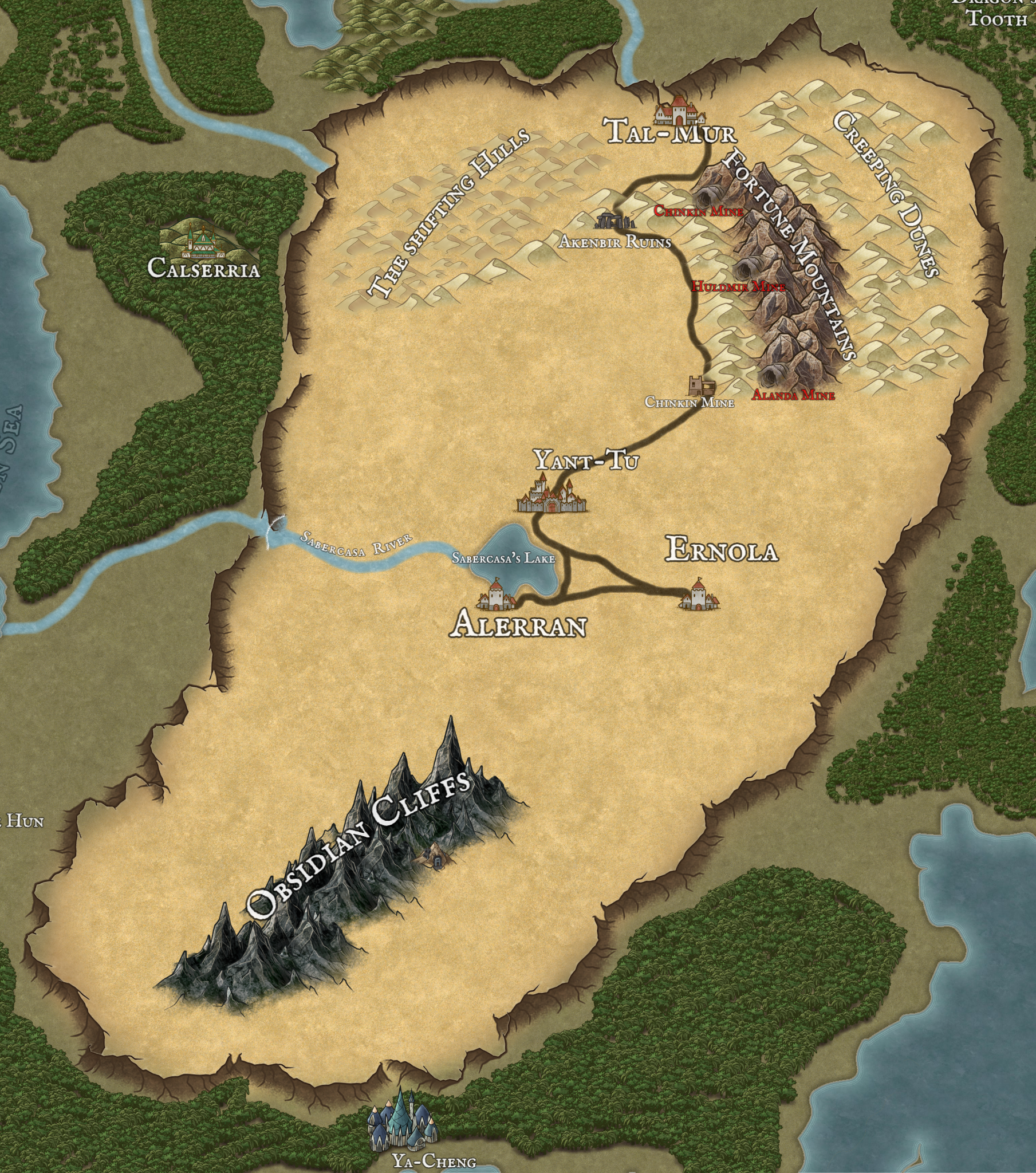
The first actual city, however, is known to have been established by the first king of the kingdom. That was finished around -300 on the holy calendar. It is said, the king commanded water to come from the ground and it did. A spring opened up and created a lake in the middle of the desert. The first city of Yant-to was established along the shores.
Trade initially was only possible through airship, however in about year 10 on the holy calendar, a underground passage was found to exist that leads from the low lands through the interior of the plateau and from a small group of hills just outside Yant-to. A second path was found to the north, an exterior path that winds down the side of the plateau, this overland method is preferred as it is the safest. Many caravans that attempted the underground passage had never been seen again.
Today, the kingdom sports a vast population and there are several large cities with smaller desert communities around old watering holes. There is still a large population that is nomadic and still follow the older ways, this causes friction between the city dwellers and the nomads. Throughout the kingdoms entire recorded history there have only been two recorded wars, the first was started (year 65) through a disagreement between noble brothers and the second (year 178) when an upstart nomad gathered forces to attack and destroy the city dwellers. Both wars were short lived lasting only a few months at most.
Obsidian Cliffs
A large stand of black rock peaks jetting some 22,000 feet above the plateau. The cliffs are surrounded by an inhospitable desert. Water is very scarce and most of the water flowing off of the cliffs is contaminated with heavy metals with a very high acid content. There are a few oases at the base of the cliffs from underground springs. The cliffs hold vast amounts of precious metals and gems buried deep in the mountains. The cliffs, however, are dangerous to mine, the rocks that form the exterior are sharp like glass by strong like granite. Hence the name obsidian cliffs. The area can not support any prolonged settlements, so all supplies are required to be brought in, in addition to the elementals and other desert dwelling creatures that roam the dunes.
Hidden throughout the cliffs are carved out prisons. These are know as the “Dragon Prisons”, a place of power where the most unrulily or dangerous dragons are put to serve out extremely long sentences. The prisons are generally protected by a magical barrier that prevents wanders from accidentally entering and to prevent the dragons from leaving. Rumors have it that dragons are not the only thing in the prison. There have been tales told of powerful liches and demon like creatures have also been imprisoned here.
Akenbir Ruins
Located at the southern edge of the shifting hills along the trade road to Yant-To, this is a popular stopping point for overland caravans. The well is fresh and always plentiful, and if staying only a single night nothing bad generally happens. Those that stay longer that a single night, tend to disappear.
The ruins are vast, mostly covered by sand, most expeditions to this area never came back. The knowledge they uncovered disappeared with them. When rescuers arrived, there was no signs of a camp every being there, therefore no trail to follow. For these reasons, the age of the ruins, or who built them remain unsolved.
Chinkin Inn
This inn is located at the base of the Fortune Mountains and is a safe location to spend a few days to recover from the desert trip, or to prepare for is. The inn has plenty of clean water and food, as carvans trade food for lodgings and other items. On a good day, several caravans can be at the inn at one time. They will open their store to wanderers, traveller and adventurers, and normally at a discount price. Many adventurers and mercenaries stay at the inn to hire out as caravan guards.
| Population | a84,700,000 |
| Capital City | Yant-To |
| Government Type | Monarchy |
| Leader | Hiram Throgmorton |
| Military | 1,000,000 |
| Allies | None |
| Enemies | None |
| Races | Human (70%), Half-Elf (15%), Halfling (10%). Half-Orc (5%) |
| Language | Qua, common |
| Currency | Empire Coins |
| Corruption Level | 50% |
| Primary Religions | Theina Laurits Ransi Dollama Ahr Nuvine Palmir Thisu Tarafey Wimdrom Quesin |
| Banned Religions | Jungrin, Ret, Talos, Dri |
| Guilds | Open Thieves Guilds |
Trade Goods: Wool, Silk, Glass, Ivory, copper, dates, figs, grapes
Manufactured goods: Carpets, clay pots, jars and jugs. Glass art, Glassware, wine.
Imported Goods: Wood, granite, marble, wheat, rice, citrus.