
Creatures, Monsters, and Beasts
Resources
Illithids (Mind Flayer)
Information
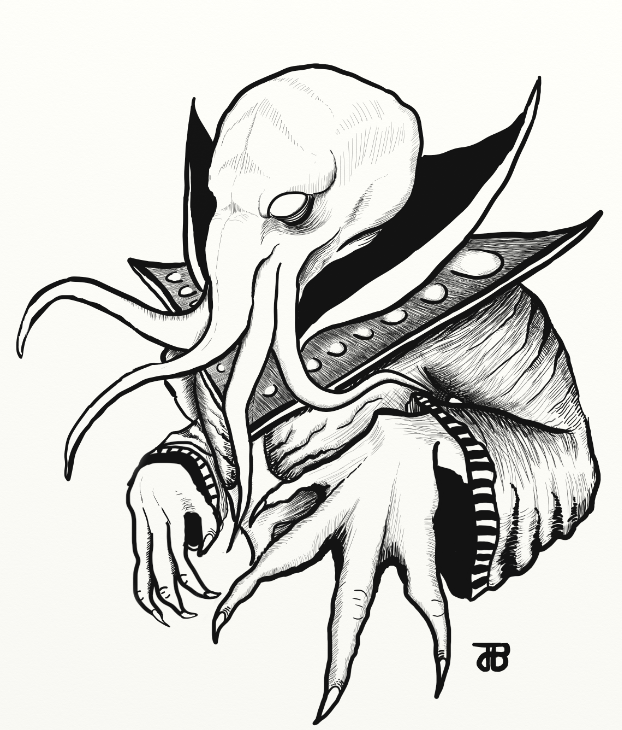
Head: Illithids possess elongated and ridged heads coated with mucous. Many have likened the illithid head to that of an octopus: however, standard illithids possess only four tentacles. This comparison may account for the many apocryphal stories and diagrams describing mind flayers with beaked mouths. Unlike most other humanoid races, illithids completely lack the ability to sense odor in their environment. Their psionic capacity somewhat compensates for this missing sense—though it remains a weakness sometimes exploitable by clever opponents.
Eyes: The eyes of a living illithid are featureless and white, similar in appearance to blind cave fish that have evolved away from the need to register visible light. This comparison, however, is inaccurate. Illithids possess supernormal visual capacities in the infrared spectrum; the pale sclera coating illithid eyes screens out all visible light but allows infrared light easily. The sclera also insulates the illithid's own body eat from its infravisual organs. Thus, illithids always perceive the world with infravision, whether in the dark or in bright light Unlike other races that possess less developed senses of infravision, the illithids' infravisual clarity compares favorably with normal vision within its functional range. This range decreases in brighter light due to the increasing “polarization” of the white sclera.
Tentacles: The most disturbing aspect of an illithid's physical anatomy is its tentacle cluster. An illithid's tentacle is an elongated, flexible, unsegmented extension used for feeling, grasping, and procuring nourishment. Each tentacle measures between 2 to 4 feet in length in the mature illithid, although illithids possess full voluntary control over these appendages, the tentacles are apt to writhe and undulate absentmindedly while the creatures engage in actions not requiring them. In addition, illithid tentacles punctuate mental communication, manipulate special tools, and allow mind flayers to read their special qualith. Despite its multiple uses, a tentacle's primary function remains that of brain extraction. As shown in the anatomical cross section, an illithid tentacle houses a thin duct that runs from a gland located near its base to the tentacle's tip, The gland (one per tentacle) secretes and stores a powerful flesh-and-bone-dissolving enzyme that enables an illithid to insert its tentacles quickly into the brain case of its intended victim. The enzyme rapidly deactivates on contact with air, and all attempts to harvest the enzyme from slain or captive illithids renders the enzyme inactive.
Mouth: Like the lamprey, an illithid possesses several rows of horny teeth set in a circular, jawless mouth beneath overhanging tentacles. Unlike a lamprey, however, an illithid's mouth cannot rasp a hole in its victim's body. Instead, an illithid uses its teeth to masticate and swallow exposed brain tissue extracted from the victim's skull. Additionally, these creatures breathe through their mouths, as they lack nostrils. The absence of mind flayer vocal cords— as well as the lack of an oral cavity suited to shaping speech—renders illithids mute. Psionic ability allows illithids to communicate with each other and any sentient species, despite their verbal deficit. At will, they can use line-of-sight telepathy to communicate with any creature; this power does not inhibit their use of other psychic abilities. A few accounts give examples of mind flayers talking or yelling; the authors of these stories mistakenly attributed psionic communication for actual speech, unaware that telepathic communication is the only way illithids can “speak.”
Skin and Mucous: The moist, supple skin of most amphibians absorbs water and oxygen. Illithids differ in that their hideous mauve skin glistens with a thin layer of mucous, preventing the epidermis (outer layer of skin) from passing oxygen. However, the mucous does keep essential moisture sealed in. Below the lower layer of the skin (called the dermis), mucous glands constantly replenish this coating. The glandular secretions give some illithids faint odors (detectable only at close range, but undetectable to other illithids) like onion, garlic, and even vanilla. While regulating skin moisture is vital, illithid mucous serves another equally important role in illithid physiology: The mucous is partially psi-active, Sages theorize that this mucous acts as a psychic resonator, amplifying the personal psionic might of individual illithids and reducing the mental strain of psychoportive powers by easing illithid penetration into the Astral and Ethereal Planes. Conjecture further points to the mucous as the source of the mind flayers' significant magic resistance. The psi-active material seems, by its very nature, to repel magical effects. Quick to take advantage of the psionic amplification qualities of their epidermal mucous, illithids have incorporated excess slime into psionic items, However, the same mucous, when removed from a living illithid body, loses all ability to resist magic. Nonillithids remain mostly unaware of the true psionic capacity of the mucous—though rumors tell of some human mages who possess a formula for a potion of ESP that uses illithid mucous as an effective ingredient.
Hands: As shown in various renderings, illithids possess hands that are quite humanoid in appearance—except for the lack of an index finger. The three remaining fingers and thumb possess mauve to red shading. Illithid nails are thick and black; however, they are too blunt to deliver an effective claw attack.
Feet: Illithids are rarely seen without distinctive two-lobed boots. Beneath this covering, illithids possess two-toed feet conjoined by thin webbing. While wearing boots, this webbing remains folded. However, when illithids remove their boots to relax in lounge-basins, the two toes flex widely, allowing the webbing to enhance illithid swimming speeds. The webbed toes are a remnant of an illithid's pre-ceremorphic origins
Ecology
The hermaphroditic mind flayer spawns twice during its entire life, depositing a gooey clutch of clear eggs measuring one-sixth of an inch in diameter each. Each clutch contains approximately one thousand eggs, all bound together by a sticky mass of illithid mucous. The illithids deposit each egg clutch along the moist inner edge of a briny pool, just above the surface of the fluid; the pool basin usually extends at least 2 feet above the fluid's surface. Several unhatched clutches laid by different illithids often simultaneously coat the inner edge, making it slick and lumpy in appearance. After a period of only one month, the eggs hatch, releasing small, writhing tadpoles into the waiting fluid below.
Without exception, the briny pools used for spawning appear in the protected center of an illithid community; these pools serve as aquatic nurseries for immature illithids and house illithid elder brains (see below). Illithids begin their lives in the briny pool as tiny mauve tadpoles that breathe by means of external gills instead of lungs. At first, a tadpole does not possess a definite shape, nor does it have a tail. Furthermore, its mouth is simply a V-shaped Illithids that lose their mucous coating through disease, inadvertent molting, or torture also lose half their base Psionic Power Point value until the mucous rejuvenates (a twenty- four-hour process in a healthy, unmolested illithid). An illithid's magic resistance also degrades if mucosal integrity is compromised. An illithid completely devoid of its slimy covering loses all but a base 18% of its magic resistance. As mucous regenerates, magic resistance also regenerates at a rate of 3 percentage points per hour. After 24 hours, both the mucous and magic resistance return to normal (90% magic resistance). Mind flayers unable to rejuvenate their mucosal layer suffer damage per day due to water loss, until death finally occurs. Mucous – Magic Resistance? sucker located on the underside of its body. As its head grows, a tadpole develops a round mouth with a homy rim. At the same time, it sprouts four tentacled growths connected by translucent webbing; these growths serve as the young illithid's tail. This tadpole stage lasts for a full 10 years, during which time the illithid continues to grow and develop. An illithid tadpole subsists on an allowance of brainmeal prepared by adult mind flayers. The fatty brainmeal provides essential nutrients for a tadpole's survival although portions of raw brains might suffice for its nutritional requirements in the absence of the prepared formula. Those tadpoles surviving a full decade reach a length of 3 inches from head to tentacle tip and look somewhat like elongated miniature octopi. Illithid tadpoles are sub sentient throughout their development, remaining defenseless in the face of aggression. Most of the tadpoles in a clutch do not survive to maturity (only 1:1000 survive). The unlucky majority is subject to predation by the elder brain residing in the pool's depths. Mature illithids view any surviving tadpoles as the best of the clutch, suitable candidates for ceremorphosis.
Cerernorphosis is the eerie transformative process wherein an illithid tadpole becomes an adult. The name for this closely guarded llithid secret comes from the Elder Tongue—cere means “brain.” and morphe means “form.” Ceremorphosis begins when an adult illithid inserts a mature tadpole into the ear of a helpless humanoid. The tadpole burrows into its victim's brain, quickly consuming much of the gray matter and replacing the consumed brain with its own squalid tissue. In effect, the tadpole melds with the uneaten lower brain stem of the victim, killing all remnants of the personality and spirit of the victim, while leaving the physical body a live for the tadpole to use as its own body. Within days, additional morphological transformations, additions, and subtractions complete the genesis of the mature mind flayer.
Ceremorphosis completely replaces the original tissue of the victim with illithid tissue; when the transformation is complete, the original victim is dead. Cure disease, remove curse, raise dead, restoration, resurrection, and/or similar spells cannot reverse this process. Furthermore, the illithid bears no resemblance to its victim following cere-morphosis, nor does it bear any of its victim's sexual characteristics. Adult illithids exercise extreme care in the selection of humanoid victims for tadpole implantation. Only certain humanoid races are acceptable, and then only individuals within a particular height and weight range. Illithids often choose victims for ceremorphosis tram the healthiest specimens in their slave pits although they also cull victims from underdark or surface world raids to assure the very best stock.
Once tadpole implantation occurs, the victim is doomed. A tadpole requires only three rounds to burrow into its victim's brain, after which it immediately subsumes the creature's personality, replacing it with its own awakening intellect. Generally speaking, the point of no return occurs one hour after implantation. Any time after this, it is impossible to restore the victim; his or her spirit seeks its fate in the Outer Planes. Ceremorphosis continues normally for the emerging illithid, during which time it remains helpless. The transformation from humanoid to illithid tissue concludes in seven days.
An adult illithid stands roughly 6 feet tall and weighs in at 170 pounds, on average. Generally speaking, adult illithids possess a height and weight similar to that of their humanoid victims prior to ceremorphosis. Since illithids are hermaphroditic, no sexual differentiation is possible between individuals. Mind flayers are warm blooded and subject to the harmful effects of extreme heat, cold, and other hostile environmental conditions. Of course, many individuals possess mental powers that mitigate or completely alleviate the discomfort or lethal nature of such environments. From the time an illithid comes into its adult form, it can expect to live anywhere from 115 to 135 years. During this period, it grows in psionic power, formulates plans for the conquest of all other races, accumulates a harem of slaves, and eats brains.